The 2025 AI Agent Revolution in Consulting: Market Analysis & Strategic Implications
April 17, 2025
The 2025 AI Agent Revolution in Consulting: Market Analysis & Strategic Implications
Introduction
The consulting industry stands at an inflection point. Artificial intelligence, once primarily used for basic automation and data analysis, has evolved into sophisticated agent systems capable of transforming how consulting work is delivered. This article examines the market dynamics, technological breakthroughs, and strategic implications of AI agents in the consulting industry.
Market Size & Growth Trajectory
The numbers tell a compelling story about where the industry is headed:
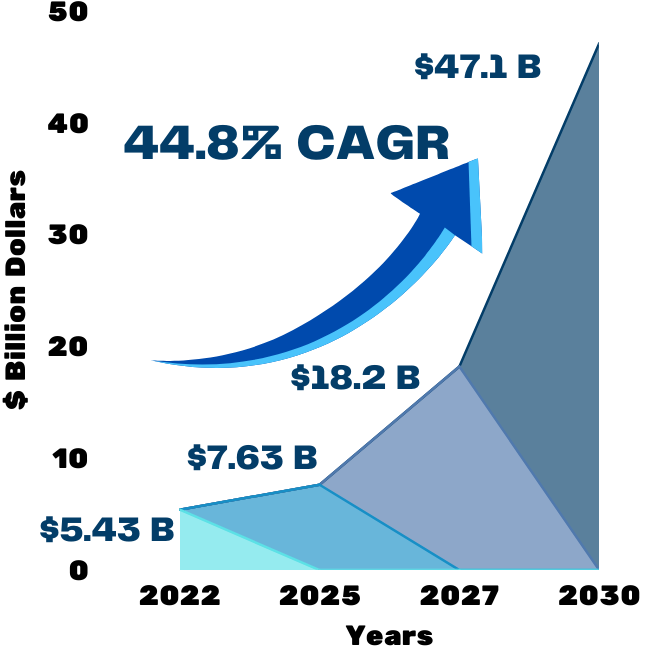
- ■The global AI agent market is projected to reach $7.63 billion in 2025, representing a substantial increase from $5.4 billion in 2022
- ■This market is expected to surge to $47.1 billion by 2030 with a remarkable 44.8% CAGR (2024-2030)
- ■North America currently dominates with 40% of global market share, while Asia-Pacific shows the fastest growth at 49.5% CAGR
- ■Most notably, 85% of enterprises are implementing AI agents in 2025, with 80% of organizations planning integration by 2026
This rapid adoption represents not merely an evolution but a fundamental reimagining of consulting service delivery.
How AI Agents Are Transforming Consulting
From Labor-Led to Intelligence-Augmented Models
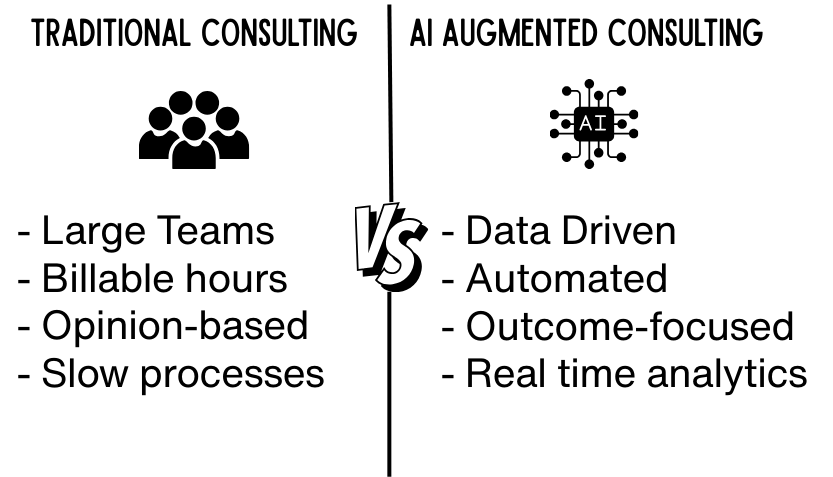
The traditional consulting business model—characterized by large teams, billable hours, and opinion-led deliverables—is being fundamentally disrupted as AI agents handle increasingly complex tasks:
- ■86% of consulting buyers are actively seeking services incorporating AI and technology assets
- ■66% of clients indicate they will stop working with consulting organizations that don't incorporate AI into their offerings
- ■By 2026, executives expect consulting spend to exceed 4% of total revenue
- ■Nearly all executives (95%) believe generative AI will be at least partially self-funded through efficiency gains by 2026
This shift represents a fundamental change in how value is created and delivered in consulting engagements.
Key Technical Innovations Driving Change
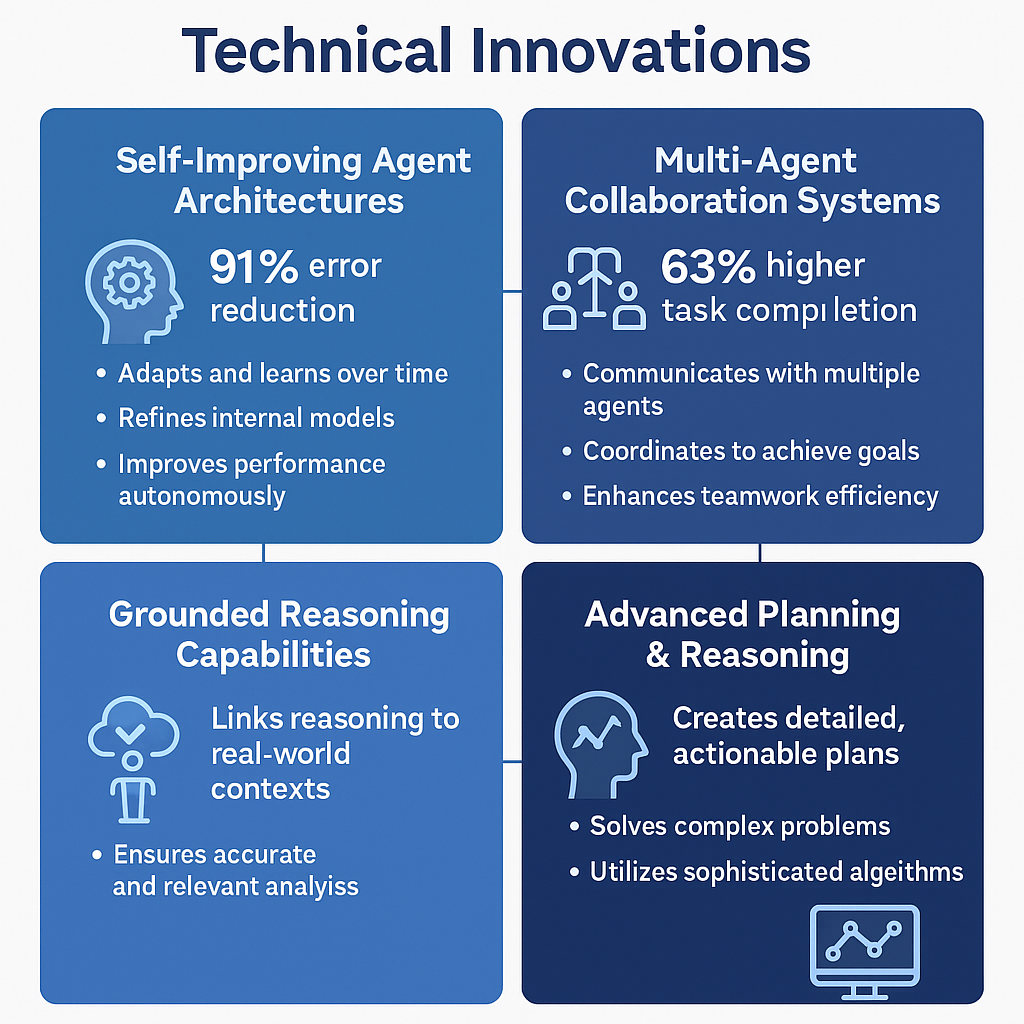
Four technological breakthroughs are enabling this transformation:
1. Self-Improving Agent Architectures
- ■Constitutional AI frameworks enabling agents to autonomously refine reasoning processes without full retraining
- ■Continuous knowledge updating for extended operational lifespans in rapidly evolving domains
- ■Self-critiquing mechanisms that progressively enhance performance through deployment
2. Multi-Agent Collaboration Systems
- ■Specialized agent teams achieving 63% higher task completion rates for complex workflows
- ■Orchestration frameworks enabling diverse skill convergence for optimal outcomes
- ■Role-based collaboration with human consultants to enhance both machine and human performance
3. Grounded Reasoning Capabilities
- ■Real-time verification modules reducing factual errors by 91% in enterprise applications
- ■Continuous validation against reliable knowledge sources to ensure accuracy
- ■Integration with proprietary knowledge bases and client systems to ensure relevance
4. Advanced Planning & Reasoning
- ■Chain-of-thought training enabling sophisticated problem decomposition
- ■Increased context windows for handling complex, multi-step consulting tasks
- ■Function calling capabilities to leverage specialized tools and datasets
Leading AI Agent Tools for Consultants in 2025
The market has rapidly developed specialized tools for consulting applications:
Strategic Analysis Tools
- ■Gamma.ai - Predictive modeling and time series analysis platform ($299/month)
- ■DataRobot - End-to-end AI lifecycle automation for building and deploying predictive models
- ■Alteryx - Data analytics platform for automating data prep and advanced analytics without coding
Project Management & Workflow
- ■TARA AI - ML-powered project management predicting task delivery times ($5/user/month)
- ■Motion AI - Platform for building conversational interfaces and virtual agents ($10/month)
- ■Fireflies.ai - AI meeting assistant for transcription and action item identification (free tier available)
Client Engagement & Communications
- ■D-ID Agents - AI-powered video avatars creating face-to-face digital interactions
- ■HeyGen - Content generation tool for marketing campaigns and social media
- ■VEED.IO - AI-driven video editing with text-to-video and voiceover capabilities ($12/month)
Market Intelligence & Analysis
- ■Signal AI - AI-driven insights from news, blogs, and reports for tracking industry trends
- ■Tableau - Data visualization tool for exploring and presenting data ($70/user/month)
- ■Otter.ai - Transcription tool using speech recognition models ($8.33/month)
Industry Applications & Use Cases
The application of AI agents varies significantly by consulting domain:
Financial Consulting
- ■AI agents reducing financial reporting time by up to 78% through autonomous software navigation
- ■Fraud detection systems identifying patterns beyond human capability in real-time
- ■Automated compliance checks ensuring regulatory adherence across jurisdictions
Management Consulting
- ■Process optimization through multi-agent systems that simulate and evaluate hundreds of workflow variations
- ■Market research agents delivering insights at 3-5x the speed of traditional methods
- ■Change management assistants providing real-time feedback on implementation progress
Technology Consulting
- ■Code-writing agents reducing development time for client projects by up to 40%
- ■Architecture evaluation systems identifying technical debt with 94% accuracy
- ■Security vulnerability assessment through continuous scanning and threat modeling
Healthcare Consulting
- ■Diagnostic assistance delivering expert-level radiological interpretations
- ■Resource allocation optimization reducing operational costs by 15-20%
- ■Clinical pathway analysis identifying inefficiencies across patient journeys
Future Market Trends
Four key trends are emerging that will shape the market over the next 24-36 months:
1. Vertical Specialization Premium
- ■Healthcare-focused AI agents commanding 12.8x revenue multiples vs. 8.3x for horizontal platforms
- ■Domain-specific solutions showing clearer paths to revenue and immediate ROI
- ■Specialized knowledge acquisition becoming the primary competitive differentiator
2. Deployment Speed Advantage
- ■Platforms offering 72-hour implementation (vs. industry average of 5 months) showing significantly higher customer acquisition rates
- ■Emphasis on no-code/low-code interfaces for consultant configuration
- ■Pre-trained models for specific industries significantly reducing time-to-value
3. Data Moats as Competitive Differentiators
- ■Continuous ingestion of domain-specific data creating defensible knowledge graphs that improve over time
- ■Proprietary datasets emerging as the most valuable assets in the AI agent landscape
- ■Strategic partnerships formed specifically to gain access to exclusive data sources
4. Shifts in Software Investment Models
- ■AI agents customizing and extending the life of existing enterprise systems
- ■Reduced investment in premium software upgrades as agents fill functionality gaps
- ■Integration capabilities becoming the primary selection criterion for new tools
Implementation Strategy for Consulting Firms
For consulting firms looking to lead rather than follow in this transformation, three strategic imperatives emerge:
1. Building AI-Enhanced Service Offerings
- ■Create hybrid teams of human consultants and specialized AI agents
- ■Develop proprietary agent frameworks tailored to specific consulting domains
- ■Establish clear governance frameworks for AI agent operation
- ■Design new service packages that leverage AI capabilities while preserving high-value human insights
2. Team Transformation
- ■Shift from large teams to smaller groups working alongside multiple AI agent types
- ■Develop agent supervision as a core consulting skill
- ■Train employees at all levels in responsible AI practices
- ■Implement new evaluation metrics focused on value creation rather than billable hours
3. Pricing Model Evolution
- ■Move from time-based to outcome-based pricing structures
- ■Develop new value metrics that account for AI agent contributions
- ■Consider subscription models for ongoing AI agent support
- ■Create transparent pricing models that reflect the reduced human effort but increased value delivery
Conclusion: The Path Forward
The integration of AI agents represents not just an operational shift but a fundamental reinvention of consulting's core value proposition. By 2025, the distinction between leading and lagging firms will increasingly be defined by their ability to effectively deploy and leverage these autonomous systems.
As the market reaches $7.63 billion in 2025 and accelerates toward $47.1 billion by 2030, consulting firms face a clear imperative: embrace AI agents as collaborative partners or risk obsolescence. The winners in this transformation will be those who combine human expertise with AI capabilities to deliver unprecedented speed, depth, and value to clients.
The question is no longer whether AI agents will transform consulting, but how quickly and effectively firms will adapt to this new reality.