Netflix VRIO Analysis: Is the Algorithm an Unbeatable Advantage in the Streaming Wars?
The streaming wars have intensified dramatically, with companies like Disney, Amazon, and HBO investing billions to challenge Netflix’s dominance. Yet Netflix continues to lead with 260 million paying customers worldwide. This analysis applies the VRIO framework to dissect Netflix’s content algorithm.
Netflix VRIO Analysis: Is the Algorithm an Unbeatable Advantage in the Streaming Wars?
The streaming wars have intensified dramatically, with companies like Disney, Amazon, and HBO investing billions to challenge Netflix’s dominance. Yet Netflix continues to lead with 260 million paying customers worldwide, adding over 13 million subscribers in Q4 alone. While competitors focus on blockbuster content acquisitions, Netflix’s real weapon lies deeper: its recommendation algorithm. But is this technology truly the unbeatable moat everyone assumes it is?
This analysis applies the VRIO framework — a rigorous strategic tool — to dissect Netflix’s content algorithm and determine whether it provides a sustainable competitive advantage that can withstand the mounting competitive pressure.
What is the VRIO Framework? A Strategic Foundation
Developed by Jay Barney, the VRIO framework evaluates whether a resource creates sustained competitive advantage by asking four critical questions:
- Valuable: Does it enable the firm to exploit opportunities or neutralize threats?
- Rare: Is it controlled by only a small number of competing firms?
- Inimitable: Do firms without the resource face significant cost disadvantages in obtaining it?
- Organized: Is the firm structured to fully exploit the resource?
Only resources that satisfy all four criteria create sustained competitive advantage.
Applying VRIO to Netflix’s Content Algorithm
A) Is the Algorithm Valuable? Absolutely.
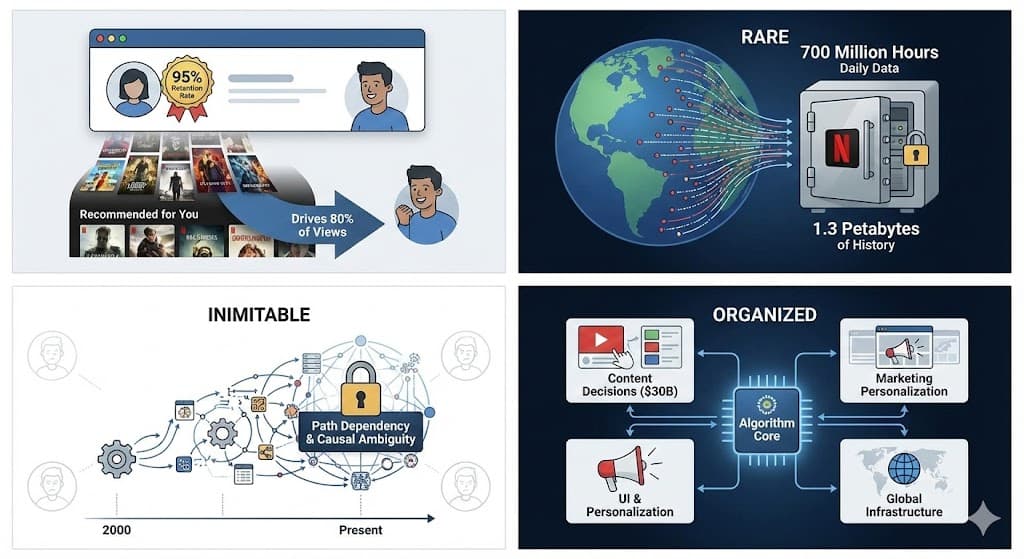
Netflix’s algorithm delivers extraordinary value across two dimensions. First, it drives 80% of all content viewed on the platform, directly influencing user engagement and retention. The algorithm achieved a 95% user retention rate, significantly reducing the costly churn that plagues streaming services.
Second, the algorithm provides strategic business value by informing Netflix’s multi-billion dollar content investments. In 2022 alone, algorithm insights influenced $29.7 billion of Netflix’s total revenue, helping the company make data-driven decisions about which shows to produce, acquire, or cancel.
B) Is the Algorithm Rare? Demonstrably Yes.
While every streaming service has recommendation engines, Netflix’s operates at unprecedented scale and sophistication. The company processes 700 million hours of daily user viewing data — a dataset that newer competitors simply cannot access or replicate.
Netflix’s machine learning model contains 1.3 petabytes of user interaction information and utilizes 53 different algorithmic signals. This isn’t just about having an algorithm; it’s about having two decades of behavioral data from a global subscriber base that no competitor can instantly acquire.
C) Is the Algorithm Inimitable? The Critical Test.
This is where Netflix’s true competitive moat emerges. The algorithm’s inimitability stems from three factors:
- Path Dependency: Netflix’s algorithm has evolved through years of continuous refinement. Its current effectiveness results from its unique developmental journey, not just current engineering capabilities.
- Causal Ambiguity: Competitors can observe the output (effective recommendations) but cannot easily reverse-engineer the complex interplay of 220 machine learning engineers, proprietary data infrastructure, and cultural integration that creates the system.
- Social Complexity: The algorithm is deeply embedded in Netflix’s data-first corporate culture. The company invests $1.2 billion annually in recommendation technology, demonstrating organizational commitment that extends far beyond technical implementation.
D) Is Netflix Organized to Capture Value? The Decisive Factor.
Netflix’s organizational alignment around its algorithm capabilities represents perhaps its strongest VRIO advantage. The algorithm doesn’t exist in isolation — insights flow directly into content acquisition, original programming decisions, user interface design, and marketing strategies.
Netflix operates across 190+ countries with cloud infrastructure spanning three major regions, processing 2.5 petabytes daily with response times under 100 milliseconds. This isn’t just technical infrastructure; it’s organizational architecture designed to exploit algorithmic insights at global scale.
Actionable Strategic Takeaways
- Resources vs. Advantages: Having sophisticated technology doesn’t create competitive advantage — having valuable, rare, inimitable, and organizationally-integrated resources does.
- Data History is Strategic Asset: In the AI era, historical data represents one of the most defensible competitive resources, particularly when accumulated over decades.
- Organizational Integration Matters Most: The hardest element for competitors to replicate isn’t the technology itself, but the organizational culture and structure that maximizes its strategic value.
- Scale Creates Compound Advantages: Netflix’s global platform creates network effects where more users generate better data, which improves recommendations, which attracts more users.
The Competitive Landscape Reality
Recent market developments validate this VRIO analysis. As one industry analyst noted, “Their competitors are so desperate to make money, they’re giving this content to Netflix”. Major studios now license content back to Netflix after years of withholding it for their own platforms — evidence that Netflix’s algorithmic distribution advantage has become too valuable to ignore.
Conclusion: A VRIO-Certified Competitive Moat
Netflix’s content algorithm satisfies all four VRIO criteria, establishing it as a genuine source of sustained competitive advantage. While competitors can acquire content libraries and build technical capabilities, replicating Netflix’s algorithmic ecosystem — with its historical data, organizational integration, and cultural alignment — represents a fundamentally different challenge.
The streaming wars continue, but Netflix’s VRIO-certified algorithm provides a defensive moat that grows stronger with scale, making it increasingly difficult for competitors to replicate rather than simply compete against.
What aspect of Netflix’s algorithmic advantage do you believe will be most difficult for competitors to overcome?