Disney’s $7.4B Masterclass vs. its $71B Cautionary Tale: A Post-Merger Integration Analysis of Pixar and Fox
A tale of two profoundly different strategic intents that led to two opposing integration philosophies. Disney’s successful acquisition of Pixar was a masterclass in cultural preservation, while its integration of Fox serves as a cautionary tale.
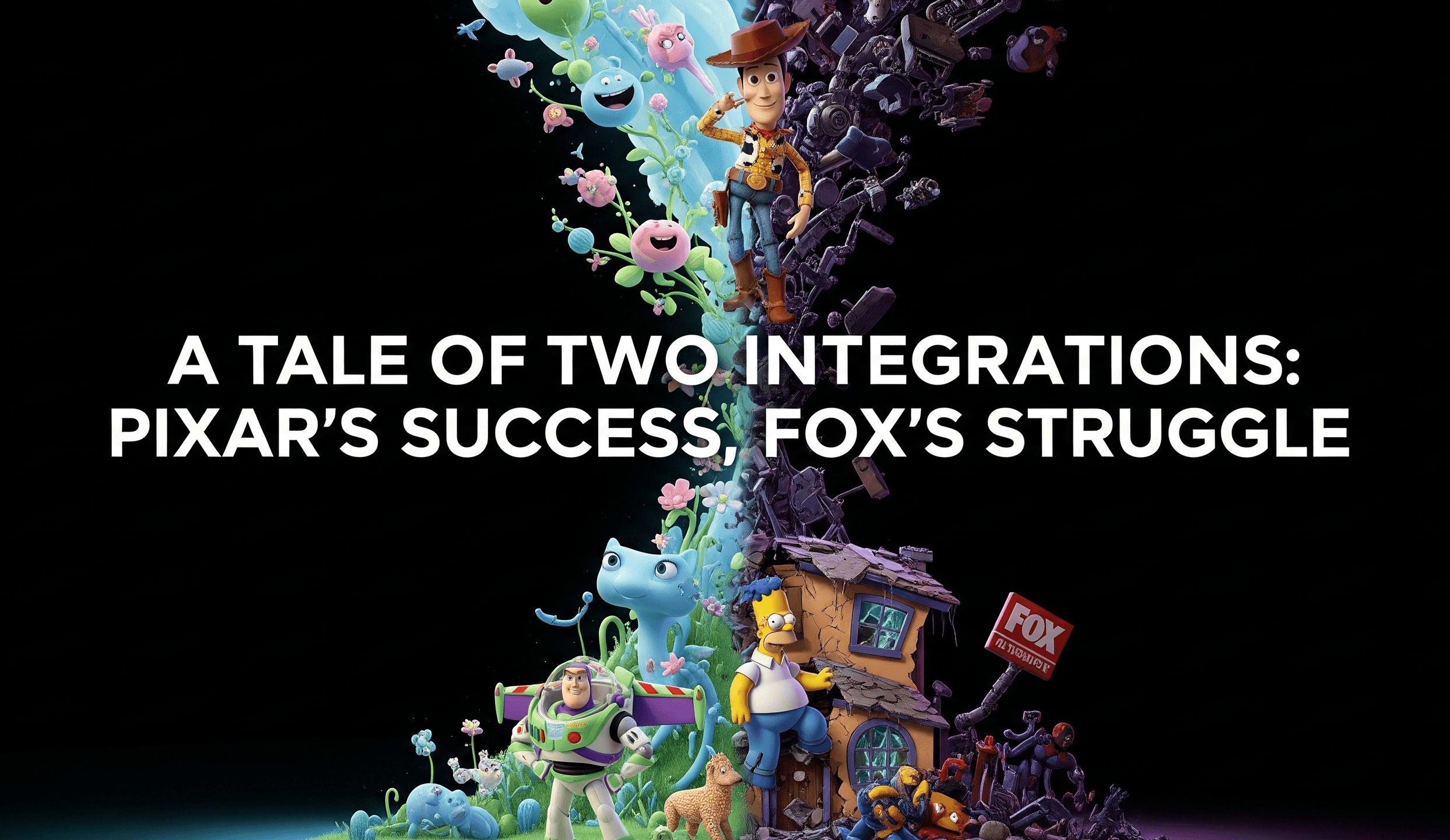
Disney’s $7.4B Masterclass vs. its $71B Cautionary Tale: A Post-Merger Integration Analysis of Pixar and Fox
How could one of the world’s most successful companies, led by the same CEO, have such drastically different outcomes with two of the largest media acquisitions in history? In 2006, Disney’s $7.4 billion purchase of Pixar Animation Studios was hailed as a masterstroke, a deal that not only saved Disney’s own animation division but created a creative juggernaut that continues to dominate the box office. Thirteen years later, its colossal $71.3 billion acquisition of 21st Century Fox — a deal nearly ten times the size — became mired in a troubled integration, marked by massive layoffs, an executive exodus, and a string of box office disappointments.
The answer lies beyond the spreadsheets and synergy forecasts. It’s a tale of two profoundly different strategic intents that led to two opposing integration philosophies. Disney’s successful acquisition of Pixar was a masterclass in cultural preservation and respecting creative autonomy. In contrast, its integration of Fox serves as a cautionary tale where a strategic focus on absorbing IP and consolidating power clashed with deeply entrenched, conflicting corporate cultures, ultimately hindering value creation. For any M&A analyst or corporate strategist, the comparison is not just a fascinating story — it’s a critical lesson in the human side of corporate finance.
The Pixar Playbook: A Light Touch
By the early 2000s, Walt Disney Animation was in a creative crisis. A string of underperforming films like Treasure Planet and Chicken Little had tarnished its legacy, while its partner, Pixar, was on an unprecedented hot streak with hits like Toy Story, Monsters, Inc., and Finding Nemo. The distribution partnership between the two was fraying, largely due to a toxic relationship between then-Disney CEO Michael Eisner and Pixar’s visionary leader, Steve Jobs.
When Bob Iger took the helm at Disney in 2005, his first and most critical strategic priority was to fix animation, the creative engine of the entire company. He recognized that Disney wasn’t just losing a partner; it was suffering from a profound creative deficit. The strategic rationale for acquiring Pixar wasn’t to buy a library of films; it was to buy a culture of innovation and the talent that fueled it. This fundamental understanding shaped every aspect of the integration.
Leadership and Autonomy: The Iger-Jobs Pact
Iger’s first move was to repair the relationship with Steve Jobs. He approached the negotiation not as a conqueror, but as a supplicant with a deep respect for what Pixar had built. This humility paid off. The terms of the deal were unprecedented in their deference to the acquired company:
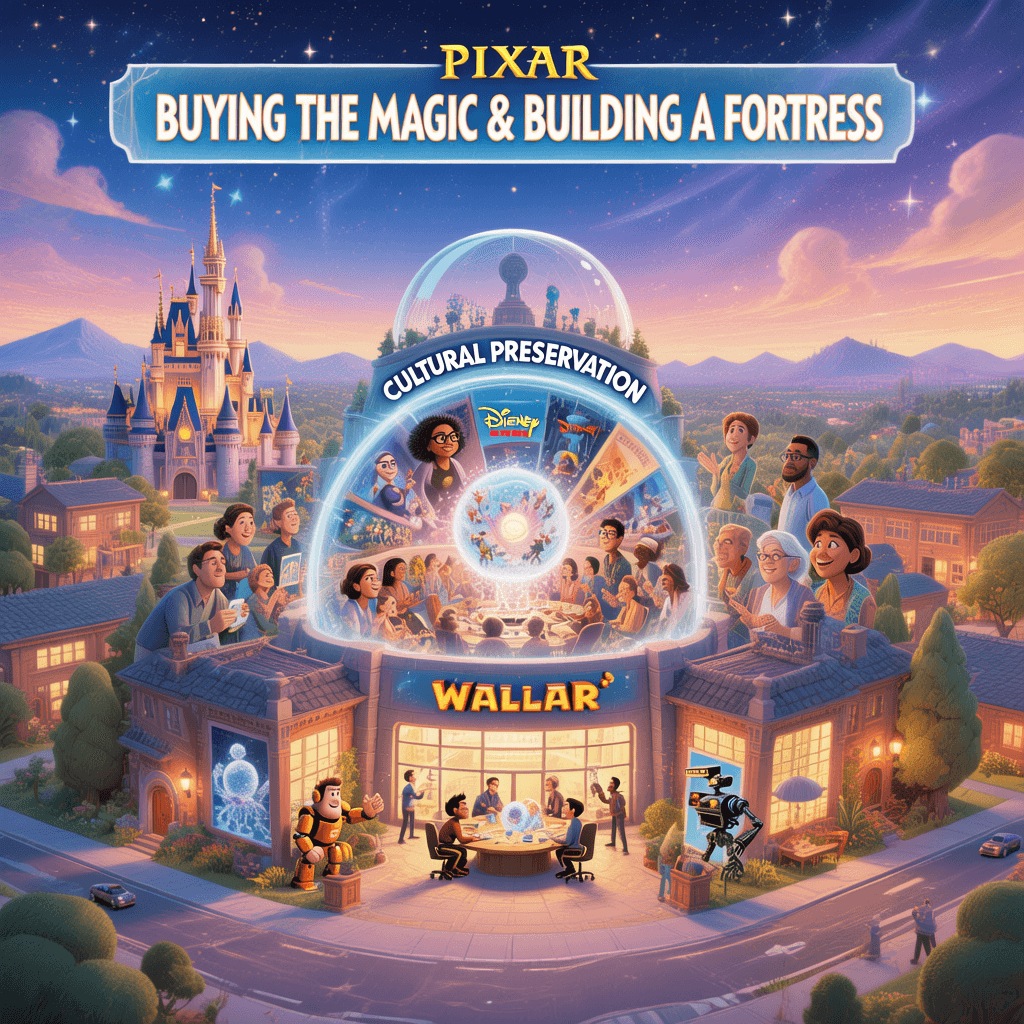
- Pixar Remained Separate: The studio kept its name, its policies, and its iconic campus in Emeryville, California, physically and culturally distant from Disney’s Burbank headquarters.
- Creative Leadership Empowered: Pixar’s creative leaders, Ed Catmull and John Lasseter, were not just retained; they were put in charge of Walt Disney Animation Studios as well. This was a clear signal that Disney was acquiring Pixar to learn from it, not to absorb it.
- Cultural Preservation Was Codified: Ed Catmull later wrote about an “absolute rule” established during the merger: neither studio could do production work for the other. This prevented Disney from treating Pixar as a mere overflow production house and protected the unique, collaborative “Braintrust” process that was the source of Pixar’s magic.
By buying the magic and then building a fortress around it, Disney ensured the creative engine it had just paid $7.4 billion for would continue to run. The results were immediate and transformative. Pixar continued its golden age with post-merger masterpieces like WALL-E and Up, while a revitalized Disney Animation, now infused with Pixar’s DNA, went on to produce global phenomena like Tangled and Frozen.
The Fox Gambit: A Heavy Hand
If the Pixar deal was about fixing a creative weakness, the 21st Century Fox acquisition was a bold, offensive move to build an empire. By 2017, the strategic landscape had changed. The existential threat was no longer a lack of creativity but the rise of streaming giants like Netflix. Iger’s strategic priority had shifted from content quality to content scale.
The primary driver for the $71.3 billion deal was to amass a vast library of intellectual property — from The Simpsons and Avatar to the X-Men — to populate the forthcoming Disney+ streaming service. The goal was not to learn from Fox’s culture, but to absorb its assets. This led to a diametrically opposed integration philosophy.
Consolidation and Culture Clash
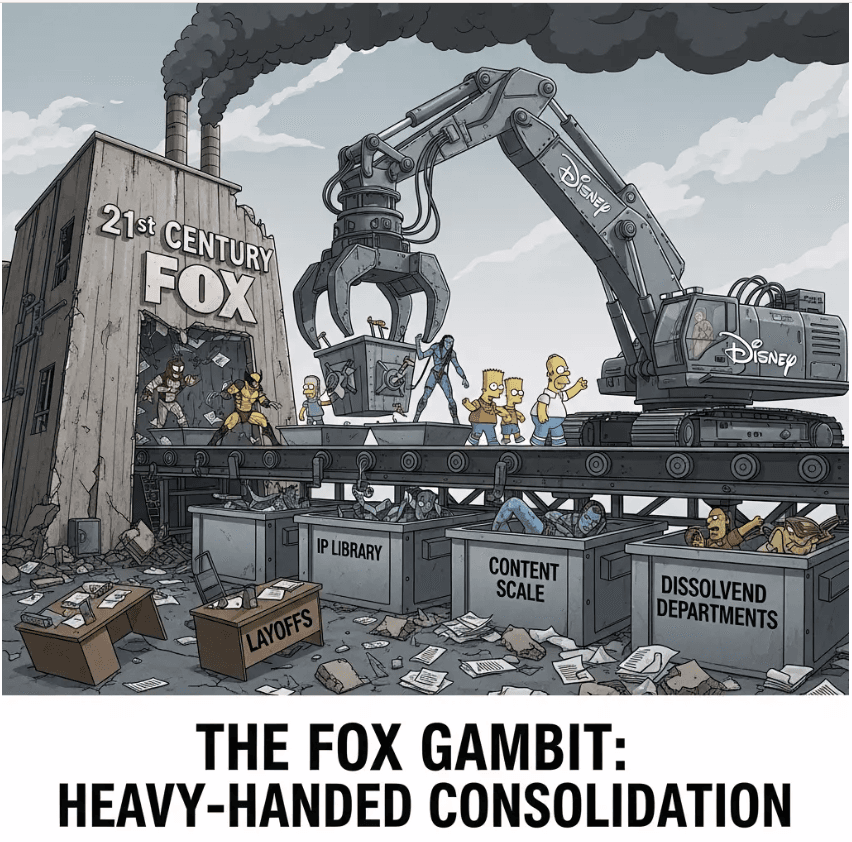
Where the Pixar integration was defined by preservation, the Fox integration was defined by consolidation. The process was swift and, for many at Fox, brutal:
- Leadership Dismantled: Unlike the Pixar deal, there was no grand pact to keep the acquired leadership in place. The Fox executive structure was largely dismantled, with key figures in distribution, marketing, and creative leadership departing in a massive wave of layoffs estimated to affect between 4,000 and 10,000 employees. The firing of Peter Rice, a highly respected veteran executive from Fox, was a particularly shocking move that signaled a clear changing of the guard.
- Operations Folded In: Overlapping divisions like marketing and distribution were consolidated to achieve a promised $2 billion in cost savings. 20th Century Fox was rebranded as 20th Century Studios, a symbolic move to distance the brand from the remaining Fox Corporation and fully bring it under the Disney umbrella.
- A Clash of Worlds: A significant “culture shock” was reported as Fox’s more maverick, creator-driven, and risk-taking culture collided with Disney’s more centralized, brand-focused, and family-friendly machine. Fox divisions like Searchlight Pictures, known for edgy, award-winning films, suddenly had to navigate a corporate parent reportedly unnerved by projects that strayed too far from the core Disney image.
The focus on asset absorption over cultural integration had consequences. The rebranded 20th Century Studios suffered a string of post-merger box office flops, and concerns grew that Disney had effectively killed the creative culture that had produced many of the valuable assets it sought in the first place. While the strategic value of the Fox library for Disney+ is undeniable, the deal has raised serious questions about value destruction within the acquired film divisions.
3 Lessons in Post-Merger Integration from Disney’s Deals
The stark contrast between these two landmark deals offers critical lessons for any leader involved in M&A.
1. Define Your “Why” Before Your “How.”
The strategic rationale for an acquisition is the single most important predictor of its integration style. Was Disney’s acquisition of Pixar’s culture more valuable than its acquisition of Fox’s IP? The answer depends on the goal. Because Disney needed to fix its creative process, preserving Pixar’s culture was paramount. Because it needed to build a content library at scale, absorbing Fox’s assets efficiently was the priority. An integration plan that ignores the core strategic driver is doomed to fail.
2. In a Creative Business, Culture Is the Asset.
The Fox deal demonstrates a critical pitfall: viewing a creative organization’s culture as a line item to be streamlined. In media and entertainment, the processes, talent relationships, and creative freedoms that define a studio’s culture are the very things that produce valuable intellectual property. When an acquirer focuses solely on harvesting the IP while dismantling the culture that created it, they risk turning a renewable resource into a finite one.
3. Leadership Humility is a Strategic Advantage.
The success of the Pixar deal was born from Bob Iger’s willingness to admit Disney’s own failings and cede control to the acquired talent. This humility built the trust necessary for a true partnership. The Fox integration, executed from a position of market dominance, prioritized consolidation and control. This highlights that in M&A, particularly when acquiring unique talent and culture, a “light touch” can be a far more powerful and value-accretive approach than a “heavy hand.”
Conclusion: The Future of Media Consolidation
The tale of Disney, Pixar, and Fox is more than just a business school case study; it’s a defining story of Hollywood’s tumultuous 21st century. It reveals the enduring tension between the spreadsheet and the story, between the synergy of consolidation and the magic of a unique creative culture.
The strategic logic behind the Fox acquisition — to build scale for the streaming wars — remains sound. However, its troubled integration serves as a powerful warning. As the media landscape continues to consolidate, the central question for the giants of the industry is a profound one: Can you buy a house and keep the magic that made it a home? Or does the very act of acquisition, driven by the relentless logic of synergy and scale, inevitably force you to renovate it beyond recognition?